Monday, 2 July 2012

Clarence Valley comes a step closer to locking the gate against coal seam gas mining


CLARENCE VALLEY COUNCIL RESOLUTION – 14.005/12 at the Ordinary Monthly Meeting on 26 June 2012:

That :

1. Further to its resolution of 12 July 2011 and 21 February 2012, Clarence Valley Council calls on the NSW State Government to immediately place a moratorium on all coal seam gas (CSG) exploration including all forms of unconventional gas extraction within the Clarence Valley local government area until appropriate State Legislation is enacted.
2. The State Government is urged to adopt appropriate policies and implement land use legislation which will effectively control and regulate the CSG industry and safeguard water, food and environmental security for future generations.
3. Development of such policy and legislation be predicated on:-
a) Gaining accurate scientific data on CSG extraction impacts;
b) The Government’s prompt and diligent consideration and implementation of the 35Recommendations contained in the 1 May 2012 CSG Report of the Legislative Council General Purpose Standing Committee No 5; and
c) Appropriate consideration of submissions received to the Draft Strategic Regional Land Use Plans for the Upper Hunter and North West of NSW.
4. Council notes the list of roads handed to Mayor Williamson at the regional rally on 12 May 2012 in Lismore by residents of the Ewingar district declaring the road reserves CSG free viz a viz Japara Road, Valley View Road, Bulldog Road, Grand View Road, Hunters Road, Peckham Road, Ewingar Road and Plains Station Road.

Voting recorded as follows:
For: Councillors Williamson, Comben, Dinham, Howe, Hughes, McKenna, Simmons, Tiley and Toms
Against: Nil


The Daily Examiner 2 July 2012:

ROSS Wilkinson, a fourth-generation farmer in the South Tabulam-Ewingar area of the Clarence Valley Shire and son of Isabel Wilkinson, renowned historian and author of "The Forgotten Country", has locked his gate against coal-seam gas mining.
At a community celebration on Saturday, June 16, a Gas Field-Free Road sign was erected on Plain Station Rd at the northern end of the Clarence Valley Shire where Ross lives.
"I've lived beside the Clarence River all my life; that's my life: the land and the river," he said.
"Without good water you've got nothing."
"You can't grow anything, you can't live. You'd have to walk off your place.
"There are hundreds of tonnes of cereal and leguminous crops grown in the area as well as thousands of head of cattle.
"We went through 12 years when it never rained and we had to irrigate all through it."
"Without being able to irrigate we've got nothing."
Mr Wilkinson is also worried about his grandkids' future, saying: "We don't own the land, we only look after it for the next generation and we've got to make sure it's in better order for them."
And he won't accept that this form of mining is safe until the mining companies prove it beyond reasonable doubt.…

Labels: , , , ,

Wednesday, 13 June 2012

The Clarence Valley does its bit to protect the Northern Rivers region from coal seam gas mining

Tuesday, 27 March 2012

Those New England vandals have reared their heads again

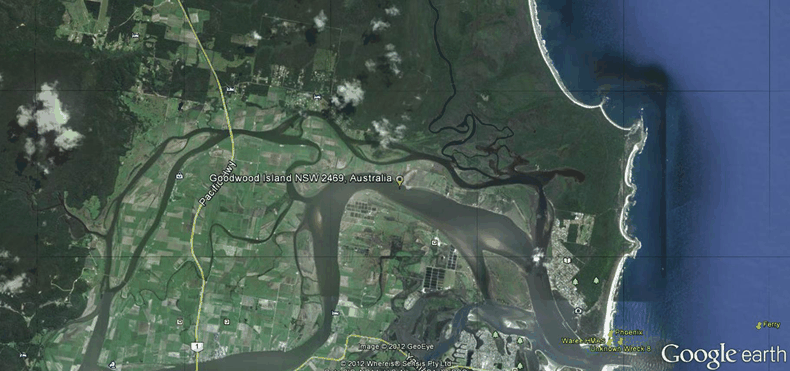
Goodwood Island in the Clarence River estuary
Click on Google Earth image to enlarge
Former President of the New South Wales Farmers Association, member of  the federal Ministerial Advisory Council on Regional Australia, current Inverell Shire Mayor and Chair of Regional Development Australia: Northern Inland NSW  Mal Peters, along with fellow RDANI committee members Les Parsons, Heather Ranclaud, Neil Argent, Scott McLachlan, Ray Tait, Matt Patterson, Jane Kreis, Melanie Dowell, Sue Price, Ian Lobsey, and Anita Taylor (in company with Inverell councillor David C. Jones) have turned their greedy eyes towards the Clarence Valley.
With a view to wrecking not only the Clarence River below Harwood Bridge, but a good part of the Valley as well.
It seems these individuals are promoting the idea of creating a Moree to Iluka-Yamba rail line running into a bulk shipping/coal terminal probably situated on Goodwood Island after deep water dredging a channel from the river mouth and, in 2010-11 formed plans to ask for an estimated $1 million to conduct a feasibility study.
Mayor Peters apparently lobbied for this idea at the inaugural meeting of the Regional Australia Advisory Council in Melbourne in mid-2011.
However, Clarence Valley residents only became widely aware of this scheme when The Daily Examiner published an article on 5 March 2012, along with this diagram:
Click on image to enlarge
As has come to be expected from industry groups and local government over the Great Dividing Range, there is little to no consideration of the environmental, cultural, economic and social costs this scheme would impose on coastal communities.
The photograph below shows the infrastructure of one typical Australian coal terminal.
Unfortunately this is exactly the type of crudely executed vandalism which would appeal to the develop to death, mining at any cost heart of the new NSW Nationals Member for Clarence Chris Gulaptis.

Labels: , , , ,

Tuesday, 20 March 2012

UNESCO & IUCN invited to see what mining would place at risk on the Dorrigo Plateau

19 March 2012
Our mission is "To raise community awareness of risks to human and environmental health"
Press Release
Invitation to UNESCO & IUCN to visit the Dorrigo Plateau
By copy of this Press Release Dorrigo Environment Watch have invited the UNESCO World Heritage Centre and the International Union for the Conservation of Nature (IUCN) monitoring team (who are currently visiting Australia to monitor impacts of mining on the Barrier Reef) to also schedule in a visit to the Dorrigo Plateau.
The Dorrigo Plateau has 4 different mining companies with current exploration licences and recent drilling has been undertaken for gold and antimony across the Plateau. There is concern that the Gondwana Rainforests of Australia World Heritage Area values could be compromised if any mining developments were approved on the Plateau.
Dorrigo Environment Watch will ask the NSW and Australian Governments to zone the plateau ano go zonefor mining to ensure that the world heritage values and vital ecosystem services (which underpin our food, fisheries, fibre and drinking water) are protected for present and future generations. Australia has an obligation to abide by our world heritage agreements to protect the Gondwana Rainforests. Ano go zonewould serve as an appropriate Government commitment and celebration for the 25 year anniversary of the World Heritage listing of our Gondwana rainforests.
For more information or comment please contact Trevor Deane on 02 6657 4005.

Labels: , , , , , , , , , ,

Sunday, 11 March 2012

What the Clarence Valley is fighting for (19)


Platypus Pool
at Wild Cattle Creek
Nymboida River sub-catchment
of the Clarence River Catchment
Short video here

Labels: , , , , , , ,

Thursday, 16 February 2012

Farmers, fishermen and conservation groups agree to fight mining in the Dorrigo Plateau and Clarence River catchments


The Daily Examiner 16 February 2012:
AN UNLIKELY coalition has formed to fight proposals to mine areas on the Dorrigo plateau.
At a meeting in Dundurrabin at the weekend, farmers, fishermen and conservation groups agreed to fight attempts to mine in the high-rainfall Dorrigo catchment.
Coffs Harbour councillor Mark Graham said there was a concerted push for the Dorrigo plateau to be declared off limits to mining.
He said there was a series of proposals for open-cut mining in the Orara, Little Nymboida, Wild Cattle Creek and Bobo areas, which was the most advanced.
"That all feeds into the Clarence, which is the regional water supply, and is the lifeblood of the Clarence Valley," he said.
"The reasons for campaigning for the Dorrigo plateau to be off-limits is for the health of the whole river and all the communities below it.
"The mining industry has said nowhere in the state is off-limits, but if anywhere should be it is the Dorrigo plateau because of its incredibly high rainfall."
Clarence Valley councillor Karen Toms said there should be no-go areas for mining and the Dorrigo plateau was one of those.
"We need to protect our water," she said.

Labels: , , , , , , , , ,

Wednesday, 18 January 2012

Anchor Resources fails to remediate Wild Cattle Creek test drill sites and is fined


Click on image to enlarge
Snapshot of Anchor Resources Ltd report to the Australian Stock Exchange
published 17 January 2012

When the China Shandong Jinshunda Group acquired this Australian registered mining exploration company it apparently did not immediately react to the evidence of its own site inspections or act on landholder complaint/s.

It was served with a notice to remediate certain test drilling sites in its Wild Cattle Creek lease area by the NSW Department of Trade & Investment Resources & Energy and fined $2,500.

Labels: , , , , , , , ,

Monday, 19 December 2011

Running counter to Anchor Resources antimony mining propaganda


From North Coast Voices on 19 December 2011:
The 101 year-old Don Dorrigo Gazette ran this letter to the editor by Jacqueline Williams on its front page in December 2011:
Mining in Dorrigo: another perspective
The article appearing in the Don Dorrigo Gazette 16/11/2011 under the heading ‘Mining in Dorrigo’ presents information that appears to be directly from an Anchor Resources brochure on the Bielsdown Project.  It would seem appropriate to question and challenge this article and highlight perhaps what we the community haven’t been told.
Anchor Resources is one of three companies holding mineral exploration licences on the Plateau and is currently the most active. Anchor Resources activities include drilling for gold at Dundurrabin, proposed drilling for antimony/gold at Wongwibinda (Fishington Mine) and further drilling at Bielsdown. This flurry of activity in our region reflects the rising price of antimony, gold and other metals and I question whether this is due to resource scarcity or market manipulation? China produces 90% of the worlds antimony, and we have seen the price of antimony skyrocket from $4K per tonne to $16K per tonne in the last two years.  This price increase has largely been associated with the closure of a number of large producing antimony mines in China due to human health/safety and environmental concerns. It is pertinent to add here that Anchor Resources is now at least 96% owned by the Chinese company Shandong Jinshunda Group as of mid 2011.
I note that Anchor Resources refer to the exploration licence process, however it is difficult to find the latest approval for their Bielsdown project with the Government gazette showing an application to renew the licence in February 2011, however this licence doesn’t appear to be granted as yet. Also of concern is that a Review of Environmental Factors (REF) has not been undertaken for any of the exploration licence applications submitted by Anchor for the Bielsdown project since 2007.  My understanding is that a REF is a requirement of all exploration licence applicants to undertake an environmental impact assessment of the proposed activities so that NSW DPI can make an assessment under the Environmental Planning and Assessment Act 1979 prior to granting the licence. Given that the Bielsdown project location has state and national significance as habitat for threatened species I question the currency of the exploration licence and how the NSW government has overlooked an important part of the approval process. This is not to mention the requirements under the Commonwealth legislation that the location triggers. It is unclear whether Anchor Resources have notified the Commonwealth government to determine if their exploration activities are considered a ‘controlled action’ under the Environmental Protection Biodiversity Conservation Act 1999 requiring further environmental impact assessment and approval. Many farmers have shared with me their frustration about their efforts and sacrifices in conserving native vegetation and habitat for the public good only to see mining companies given open slather.
I don’t wish to dwell solely on the environmental issues surrounding the potential of mining on the Plateau, as there are other issues that need to be considered. It seems that Dorrigo is not immune to the unprecedented mining expansion in regional Australia where the potential social and economic impacts need to be considered by the communities faced with these challenges. As the current legislation has been identified as inadequate to accommodate the risks, new policies are being developed and proposals to change legislation under debate. In the meantime, mining activities continue to expand.  In considering the full impacts of mining, the concerns of landholders and rural communities should not be dismissed as simply ‘alarmist’......

Read the full letter here.

Labels: , , , , , ,

Friday, 9 December 2011

China Shandong Jinshunda Group caught out over fudged claims of widespread community consultation


Editor David Bancroft writing in The Daily Examiner, 9 December 2011:
A MINING company's claim to have consulted widely about antimony mining in the Wild Cattle Creek area has been disputed by one of the area's environmental groups.
Dorrigo Environment Watch member Matt Forde said claims from Anchor Resources general manager Ian Price about community consultation did not match their own research.
Mr Price told ABC Radio on October 6 the company had consulted widely with residents, particularly in the area affected by the project.
"We are continuing that consultation into the local community," Mr Price said.
But Mr Forde said his group had members residing in the area who had received no communication, so decided to phone around to see how many had.
"Results from the survey found that 52% of landholders had received no communication from Anchor Resources, while 26% were contacted in 2009, with no further communication," he said
"Seventeen per cent of landholders had communications in 2009 and 2010 and 13% of landholders have been communicated with between 2009 to 2011.
"One of these landholders received over 96 emails from Anchor Resources in a two-year period, mostly in relation to access agreements."
Mr Price, who was in Dorrigo yesterday, said he was relatively new to the company but company records showed there had been consultation in 2009.
He said there was no timetable for drilling in the area and land access had not been negotiated.
There had been ongoing discussion with affected landowners, he said.
Once land access was negotiated, the company would undertake another round of consultation, which would be detailed.

Labels: , , , , , , ,

Monday, 5 December 2011

Here we go again ... another ratbag!


The title of this post is the exact wording of the opening sentence of an email sent by one Clarence Valley resident earlier today, alerting me to the fact that at least some of those irrigators (unhappy with the latest manifestation of the Draft Murray Darling Basin Plan) have turned their greedy eyes and intransigent hearts towards the Clarence River catchment once more.
…managing director of South Australian citrus and dairy company Nippy's, Jeff Knispel,……. Mr Knispel advocated considering the social and economic benefits of building a hydro electricity dam at the head of northern NSW's Clarence River and dropping the water into the western-flowing river system, feeding the Darling River.

Apparently the resounding “No!” communities in the Clarence catchment have been shouting for decades to every move to dam and divert freshwater to the inevitable detriment of the local economy, agriculture, industry, visual amenity, cultural significance, water sustainability/security and biodiversity is still falling on the deaf ears of faraway irrigators who believe they have a God-given right to rape and plunder Australia’s most vital natural resource.


Well, my patience is long worn out and, Nippy’s Fruit Juices Pty Ltd, Nippy’s All Seasons Pty Ltd, Knispel Bros Pty Ltd and Nippy's Waikerie Producers Pty Ltd can confidently predict that none of their product will ever be purchased by me or mine.

That, Mr. Jeff Knispel is Natually as good as it gets.

Labels: , , , ,

Saturday, 3 December 2011

Antimony becomes a dirty word on the NSW North Coast


ABC Mid North Coast News 2 December 2011:

A community alliance has been formed to oppose antimony mining on the Dorrigo Plateau.
The group is working to stop the reopening of the old Wild Cattle Creek near Bielsdown.
The alliance says the Anchor Resources plan could lead to pollution in the headwaters of the Nymboida River which feeds the Coffs-Clarence public water supply.
Coffs councillor Mark Graham says recent stormwater overflows from the old Hillgrove mine on the plateau highlight concerns.
"These are essentially pristine headwaters areas, which provide drinking and good clean water important for many of the industries in our region," he said.
"We've seen in our Macleay River, major contamination because of the mining at Hillgrove.
"We need to learn lessons from that and avoid making these mistakes again."
Cr Graham says the community is determined to be heard.
"The determining authority for mining application is state and in some instances the Commonwealth Government," he said.
"Community groups have aligned and formed together in an alliance to oppose mining on the Dorrigo Plateau."

The Daily Examiner 1 December 2011:

Chinese-owned Anchor Resources holds a licence to explore the Bielsdown site, but no approval has been issued for mining.
Groups including Dorrigo Environment Watch, Antimony Action, NSW Greens and North Coast Voices fear that any mining activity in the high-rainfall area could lead to contamination of the Clarence/Coffs Harbour water supply.
"The effects of antimony poisoning are similar to arsenic poisoning," a Greens statement on the issue said. "In small doses, antimony causes headaches, dizziness and depression.
"Larger doses damage the kidneys and the liver, causing violent and frequent vomiting and will lead to death within a few days; otherwise skin contact causes dermatitis."
The ABC's 7.30 Report covered the story about prior Hillgrove spills, their impact and the Wild Cattle Creek plans in October.

ABC Mid North Coast News 29 November 2011:

There has been another heavy metal spill into the Macleay River from a gold and antimony mine in the upper catchment.
Heavy rain over the weekend caused an overflow from a stormwater dam at the Hillgrove mine near Armidale.
The Kempsey council's infrastructure manager, Robert Scott, says the contamination sounds worse than it actually is.
He says the rain caused the spill but it also helped dilute it.
"At the moment the dams in the Hillgrove mine, because they've received around about 290mm of rainfall for the month of November alone, are full, they are discharging," he said.
"We are seeing a massive dilution factor as a result of the overall flow that's coming off the New England Tablelands at the moment, which has resulted in relatively low levels of discharge directly from the mine."
However, conservationists are worried about the latest spill into the Upper Macleay.
Coffs Harbour Greens' councillor Mark Graham says the spill in the region's drinking water catchment should be grounds for concern.
"I think that all the evidence is that the river is contaminated by mining practices and it's not just the historic mining practices," he said.
"The owners of the Hillgrove mine, Straits Mining, were recently fined $50,000 in the Land and Environment Court for ongoing contamination to the headwaters of the Macleay.
"These mines are creating ongoing contamination for the catchment.

North Coast Voices 30 November 2011:

No Antimony Mine on the Dorrigo Plateau - get your bumper stickers now


The bumper stickers are available from Kombu Wholefoods in Bellingen, The Happy Frog in Coffs Harbour, The Clarence Environment Centre in South Grafton, Sawtell Paradise Fruit, The Sawtell Newsagency, Hickory Wholefoods in Dorrigo, Dorrigo Environment Watch Inc., Antimony Action and local NSW Greens groups.
Further information about the proposed reopening of the mine and about the dangers of antimony mining in high rainfall areas is available at
http://www.dorrigoenvironmentwatch.org.au/index.html  

North Coast Voices 17 November 2011:

Just to remind our elected representatives in all three tiers of government that mercury and arsenic have consequences, here is a media report from New Zealand this month as one small community struggles with the reality of soil contamination from arsenic laden mine tailings dumped during the last century:
The Ministry of Health advises Moanataiari residents to:
- Take care with personal hygiene (i.e. hand washing after handling soil);
- Make sure children don't eat or play in soil;
- Remove footwear before going indoors to avoid carrying soil dust indoors - particularly for households with very young children;
- Cover soil (e.g. grassing, paving, gravel) to reduce dust and direct access by young children;
- Not to eat home grown fruit and vegetables, especially young children, until further quantification of the contamination is available and the risk can be assessed, unless it is known that the garden soil is clean fill. If you choose to eat home grown fruit and vegetables, then thoroughly wash produce that may be contaminated with soil, and peel the skin off root vegetables;
- Don't be concerned about the drinking water supply, it is separate (and safe);
- As always, if unwell for any reason, see your doctor.

Labels: , , , , , , , , ,

Thursday, 10 November 2011

Protect our NSW North Coast Water Supply from Mining

Coffs Harbour councillor, Mark Graham, can understand why a group of  local citizens would choose to demonstrate their concern by rallying at the Karangi Dam this Saturday at 11.00 am.
“ I have already warned that the Coffs Harbour Council’s investment in a safe water supply is at risk.
“The proposed antimony mine at Wild Cattle Creek has the potential to poison the waters of the Nymboida and Clarence Rivers. The Macleay River has already been poisoned with arsenic and antimony for millennia, a result of mining.
“It is extremely unlikely that this proposed Chinese owned mine can operate safely and remain safe after its Chinese owners have moved on. An open cut mine 1.5km long and 0.5km wide open to the sky in that extremely high rainfall area will generate an enormous amount of polluted water.
It could end up in the Karangi Dam and then in the taps of our homes, schools and nurseries.
[Coffs Harbour City Cr. Mark Graham,media release,10 November 2011]

Greens candidate for the Clarence by-election, Janet Cavanaugh, today gave her support to the rally at Karangi Dam on Saturday morning which is demonstrating against the proposed antimony mine at Wild Cattle Creek in the headwaters of the Coffs-Clarence regional water supply.
“This rally should be a reminder to the O’Farrell Government that this proposed mine is not just an issue for the Clarence electorate but also for Coffs Harbour,” Ms Cavanaugh said.
“The residents of Coffs Harbour should be demanding Andrew Fraser MP to represent their interests and secure a guarantee from the Government that no large open cut mine will be permitted in the catchment of our shared water supply.
“Voters in the Clarence Valley should be also be sending a message to Sydney by casting their vote for the candidates who are raising this issue on their behalf.
“Vague statements from the Premier that a newly formed Environmental Protection Agency will somehow guarantee the safety of our water supply are too weak. For a start, he is not recognising that compliance with pollution licensing is likely to be constrained by a lack of staff and the remoteness of the site.
“Most significantly, he is not recognising that an open cut mine in that area with extremely high rainfall will generate an enormous amount of polluted water in the Nymboida River, which could end up in the Shannon Creek Dam and also in Karangi Dam, and then our taps,” she said.
The protest picnic at Karangi Dam will be held this Saturday morning (12 November) at 11am.  [Greens Clarence by-election candidate Janet Cavanaugh,10 November 2011]

Labels: , , , , , , , , ,

Thursday, 27 October 2011

The Daily Examiner editor comments on plans to mine antimony on the NSW North Coast

Comment by David Bancroft, Editor, The Daily Examiner, Page 10, 27 October 2011:
Digging up mining dirt
MANY readers will be tempted to look at who is issuing the warning about antimony mining in our page three story today and not at what they are saying. That would be a mistake because what is being said has real substance.
Greens upper house member Jeremy Buckingham is clearly deeply concerned about the risks posed to Wild Cattle Creek and the Nymboida and Clarence rivers from proposed antimony and gold mining in the Wild Cattle Creek and Dorrigo plateau areas.
As we have said in this space previously, the consequences of a pollution spill during mining operations would have dire consequences for the Clarence and Coffs Harbour water supplies as well as the beef, dairy, fishing, horticulture and tourism industries of the Clarence Valley.
The ABC's 7.30 Report last Friday illustrated what can happen when the holding ponds of an antimony mine overflow.
It showed the Hillgrove mine, near Armidale, more than 100km from the coast. It has leaked contaminants into the Macleay River system and there are now exaggerated levels of pollutants from Hillgrove to the sea. Environment Minister Robyn Parker has already told parliament that pollution will be evident for "millennia".
Authorities are giving conflicting advice on the impact, on one hand saying there is no health threat to humans and on the other advising residents the water is unfit to drink.
Can you imagine what the impact on the tourism industry alone would be from the publicity that would surround pollution of the Clarence?
And it is just one of the industries that face potentially disastrous consequences from heavy metal mining.
We should not dismiss the prospect of mining out of hand because of the environmental risks - mining is essential.
But before we consider an application with such risks we should be absolutely certain we are not going to put long-term industries at risk for a relatively short-term gain.

Also Green's contamination fears by David Bancroft, 27 October 2011.

Labels: , , , , ,